

oh yeah, here’s the PIIGS debt position
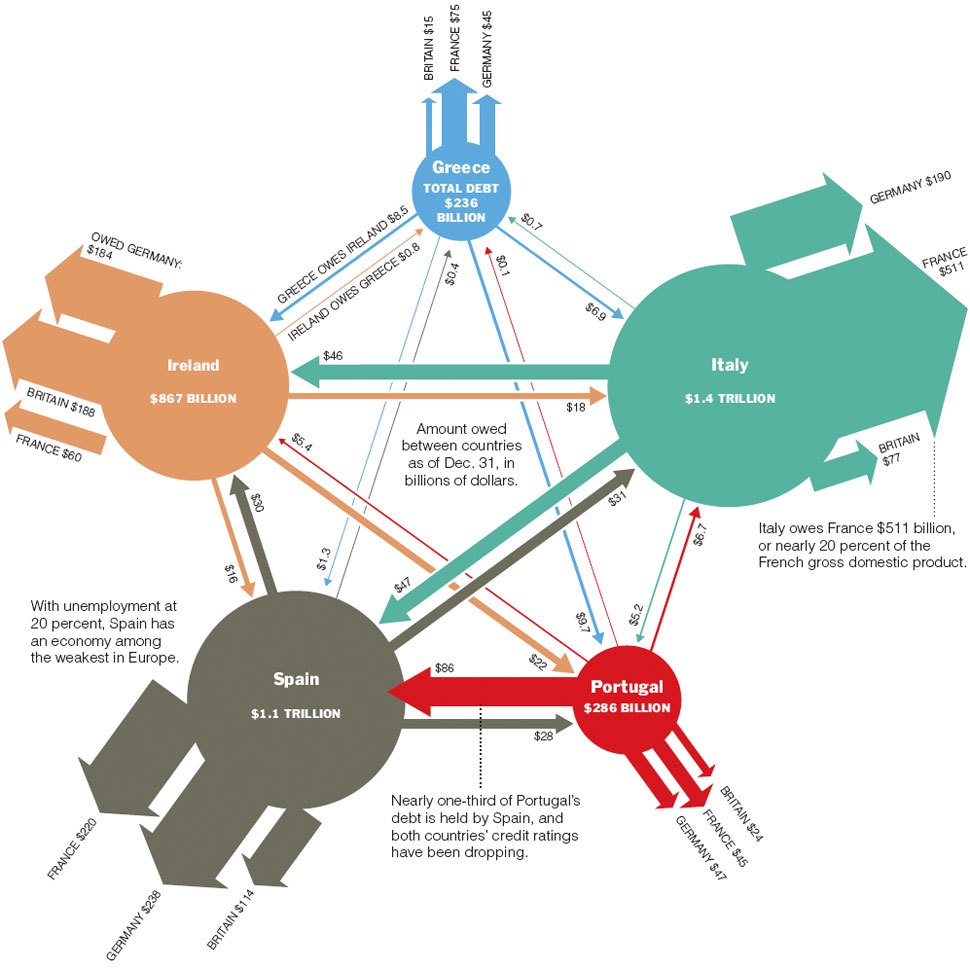
You may have seen this already, but courtesy of the New York Times: A spiffy graphic illustrating the colossal debt position of Portugal, Ireleand, Italy, Greece and Spain. It’s worth noting that the UK has a national debt of around £952 billion (or around US$1.42 trillion), so somewhere around the same level as Italy. That figure represents around 53% of British GDP, while Italy’s figure represents a proportion just less than twice that. Click for full-size.
machete – catnip for gun-toting conservative wingnuts
I’m not sure that it’s possible to come up with a more politically inflammatory trailer than this one for the US immigration nutters. I’m led to believe that the entire membership of free republic are loading their weapons as we speak.
i lied about wpbook – now with more wordbooker
Yeah, so I decided to go with Wordbooker instead cause WPBook looks a little bit like overkill for my purposes…
My apologies for yet another test post as I get this stuff working 🙂
the trouble with gdp
Here’s a quote from Robert F. Kennedy, speaking at the University of Kansas on March 18, 1968. Someone quoted a section of this in Crikey’s comments section today and with all the talk of resource taxes and mining profits, economic stimulus and gross domestic profit, it’s pretty timely.
“Too much and for too long, we seemed to have surrendered personal excellence and community values in the mere accumulation of material things. Our Gross National Product, now, is over $800 billion dollars a year, but that Gross National Product – if we judge the United States of America by that – that Gross National Product counts air pollution and cigarette advertising, and ambulances to clear our highways of carnage. It counts special locks for our doors and the jails for the people who break them. It counts the destruction of the redwood and the loss of our natural wonder in chaotic sprawl. It counts napalm and counts nuclear warheads and armored cars for the police to fight the riots in our cities. It counts Whitman’s rifle and Speck’s knife, and the television programs which glorify violence in order to sell toys to our children.
Yet the gross national product does not allow for the health of our children, the quality of their education or the joy of their play. It does not include the beauty of our poetry or the strength of our marriages, the intelligence of our public debate or the integrity of our public officials. It measures neither our wit nor our courage, neither our wisdom nor our learning, neither our compassion nor our devotion to our country, it measures everything in short, except that which makes life worthwhile. And it can tell us everything about America except why we are proud that we are Americans.”
But money helps, right? And material things make us comfortable. If an economy collapses and government revenues plummet, people might be more inclined to break those special locks or riot in the streets. So should we think more about money? Or less? Or, perhaps, think about it differently?
magical contradictions
I did tweet about this already, but it’s special enough that I’ve got to post it in full. There’s an ABC story entitled “Doubt cast over plain cigarette packaging” which quotes very authoritative NSW south coast tobacconist Brent Hardie. He claims:
“It’s like anything. If you enjoy something, you’re going to continue to smoke, you’re going to continue to drink, whatever it might be and as we’ve seen the price rises each year that the Government impose, it doesn’t stop anybody, it might die off for a week or so then people come back and buy regularly what they would normally buy, I don’t really think it’s the packaging that makes it attractive.”
Just to be clear, I’m taking from this quote that he reckons people will buy cigarettes as normal, once they get over being a bit pissed off at the price increases or package changes. He’s saying that it won’t affect cigarette sales. Okay, got it. But wait, same guy:
“There’s a lot of small businesses like myself, with these changes, it could possibly send a lot of businesses broke, I’m sure it’s going to make it very tough for us because people can only afford to spend so much on cigarettes.
“I mean there are other bills to pay, so I think it’s going to have a very big impact and I don’t think it’s going to be a good one on the retailers’ side.”
Let me check here – the government might face a class-action suit from tobacco companies and retailers because of the immense harm that these changes will do to their businesses. People only have so much money to spend, and they’ll choose to buy fewer cigarettes as a result. In fact, they won’t even spend the same amount of money as they do now and just buy fewer packs. He seems to imply they might cut back further or even give up entirely as a result of the price increase and packaging changes.
Which one is it, Brent? Will people buy as many cigarettes as always and, assuming you keep the same margins as today, therefore you’ll see an increase your profits? Or will they spend the same amount of money as always and, again assuming you maintain your margins, you’ll have the same takings as always? Or will those bastards in Canberra achieve their aims, cause large number of people to drastically reduce their consumption or quit altogether and by consequence send you broke?
I get the feeling you’ve got some kind of vested interest in decrying the changes. It might even compromise your objectivity on the issue!