Yeah, so I decided to go with Wordbooker instead cause WPBook looks a little bit like overkill for my purposes…
My apologies for yet another test post as I get this stuff working 🙂


multipurpose collection of stuff
Yeah, so I decided to go with Wordbooker instead cause WPBook looks a little bit like overkill for my purposes…
My apologies for yet another test post as I get this stuff working 🙂
Here’s a quote from Robert F. Kennedy, speaking at the University of Kansas on March 18, 1968. Someone quoted a section of this in Crikey’s comments section today and with all the talk of resource taxes and mining profits, economic stimulus and gross domestic profit, it’s pretty timely.
“Too much and for too long, we seemed to have surrendered personal excellence and community values in the mere accumulation of material things. Our Gross National Product, now, is over $800 billion dollars a year, but that Gross National Product – if we judge the United States of America by that – that Gross National Product counts air pollution and cigarette advertising, and ambulances to clear our highways of carnage. It counts special locks for our doors and the jails for the people who break them. It counts the destruction of the redwood and the loss of our natural wonder in chaotic sprawl. It counts napalm and counts nuclear warheads and armored cars for the police to fight the riots in our cities. It counts Whitman’s rifle and Speck’s knife, and the television programs which glorify violence in order to sell toys to our children.
Yet the gross national product does not allow for the health of our children, the quality of their education or the joy of their play. It does not include the beauty of our poetry or the strength of our marriages, the intelligence of our public debate or the integrity of our public officials. It measures neither our wit nor our courage, neither our wisdom nor our learning, neither our compassion nor our devotion to our country, it measures everything in short, except that which makes life worthwhile. And it can tell us everything about America except why we are proud that we are Americans.”
But money helps, right? And material things make us comfortable. If an economy collapses and government revenues plummet, people might be more inclined to break those special locks or riot in the streets. So should we think more about money? Or less? Or, perhaps, think about it differently?
I did tweet about this already, but it’s special enough that I’ve got to post it in full. There’s an ABC story entitled “Doubt cast over plain cigarette packaging” which quotes very authoritative NSW south coast tobacconist Brent Hardie. He claims:
“It’s like anything. If you enjoy something, you’re going to continue to smoke, you’re going to continue to drink, whatever it might be and as we’ve seen the price rises each year that the Government impose, it doesn’t stop anybody, it might die off for a week or so then people come back and buy regularly what they would normally buy, I don’t really think it’s the packaging that makes it attractive.”
Just to be clear, I’m taking from this quote that he reckons people will buy cigarettes as normal, once they get over being a bit pissed off at the price increases or package changes. He’s saying that it won’t affect cigarette sales. Okay, got it. But wait, same guy:
“There’s a lot of small businesses like myself, with these changes, it could possibly send a lot of businesses broke, I’m sure it’s going to make it very tough for us because people can only afford to spend so much on cigarettes.
“I mean there are other bills to pay, so I think it’s going to have a very big impact and I don’t think it’s going to be a good one on the retailers’ side.”
Let me check here – the government might face a class-action suit from tobacco companies and retailers because of the immense harm that these changes will do to their businesses. People only have so much money to spend, and they’ll choose to buy fewer cigarettes as a result. In fact, they won’t even spend the same amount of money as they do now and just buy fewer packs. He seems to imply they might cut back further or even give up entirely as a result of the price increase and packaging changes.
Which one is it, Brent? Will people buy as many cigarettes as always and, assuming you keep the same margins as today, therefore you’ll see an increase your profits? Or will they spend the same amount of money as always and, again assuming you maintain your margins, you’ll have the same takings as always? Or will those bastards in Canberra achieve their aims, cause large number of people to drastically reduce their consumption or quit altogether and by consequence send you broke?
I get the feeling you’ve got some kind of vested interest in decrying the changes. It might even compromise your objectivity on the issue!
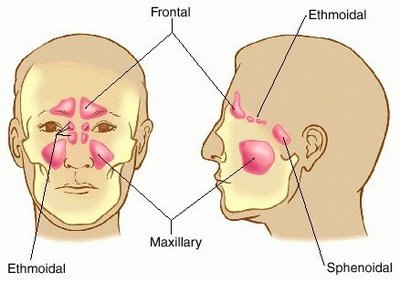 You may or may not be aware that I’ve had noggin trouble for the past month or so. Consequently, I’ve become a little preoccupied with sinuses and their buried mysteries.
Sinus is a generic term derived from latin – it means ‘fold’ or ‘pocket’. What ‘sinuses’ generally refer to are the paranasal sinuses, a collection of air-filled cavities within the bones of the skull & face. The total volume of these cavities varies from person to person but an average is about 70ml.
Why they’re there is up for debate but weight reduction for the skull, heating/humidification of inhaled air, improved vocal resonance and temperature insulation for teeth are possibilities.
Those located above & behind the eyes are called the frontal sinuses, the biggest ones found under the eyes at the front of the face are called the maxillary sinuses. The last two groups are more centrally located – the ethmoid sinuses are a group of several air cells found right between the eyes and the sphenoid sinus is right up the back there, near the pituitary gland.
Paranasal sinuses are connected to the nasal cavity via channels called ostia. The internal surfaces of the sinuses are lined with cilia to move goo around, but they’re particularly concentrated in the ostia to aid drainage into the nasal cavity. Lovely stuff. When inflammation or some other obstruction blocks the drainage, a sinus cavity can end up under pressure which is pretty painful. That would be sinusitis.
And those are today’s sinus facts! I have other sinus facts, but it gets a bit yuck from here on in.
I’ve only gotten 30 pages into this book (The Authoritarians, by Bob Altemeyer), but am already deriving a great deal of pleasure from it. Sure, I could wait to write about it until I’d finished it and then make some kind of coherent overall comment but what I’d much rather do is get some of you folks reading it too. Then we can babble about it together. Here’s a quote that may pique your interest somewhat:
Finally, just to take this to its ludicrous extreme, I asked for reactions to a “law
to eliminate right-wing authoritarians.” (I told the subjects that right-wing
authoritarians are people who are so submissive to authority, so aggressive in the
name of authority, and so conventional that they may pose a threat to democratic rule.)
RWA scale scores did not connect as solidly with joining this posse as they had in the
other cases. Surely some of the high RWAs realized that if they supported this law,
they were being the very people whom the law would persecute, and the posse should
therefore put itself in jail. But not all of them realized this, for authoritarian followers
still favored, more than others did, a law to persecute themselves. You can almost hear
the circuits clanking shut in their brains: “If the government says these people are
dangerous, then they’ve got to be stopped.”
Now, to properly interpret that quote, it’s important to understand that Bob doesn’t mean right-wing in the traditional political sense here, but right-wing in the sense of “supporting current orthodox establishment” which is rather a different thing. Anyway, it’s eminently readable and full of good humor. Give it a bash.
Here’s a link to the PDF – get cracking!
Edit: It’s 3am, just finished. Well, that certainly has given me a bit of a different perspective on a few issues. One in particular, I’m now really sure that despite how entertaining Hitchens and Dawkins are, they’re going about what they want to achieve very much the wrong way.
And I think I’m better placed to understand how a few people I’ve known have been so able to wander around with several conflicting and completely contradictory beliefs without seeing a problem.
Phew. Sleep time.
This is a highly specific and geeky kind of post, but I couldn’t find anything about this problem anywhere else on the net. Maybe by writing it here, I might help some other poor bastard who is having problems with duplicity on CentOS 5.4.
Continue reading “s3 timeout errors with duplicity on centos 5.4”